
Misaligned Markets blog post review - First year edition
Catch the highlights from the first year of the Misaligned Markets blog

I published the first Misaligned Markets blog post on January 21, 2025. I’d go on to write 17 blog posts containing a total of nearly 45,000 words over the course of a year. This isn’t a flex, but a realization and acknowledgement that my writing is pretty dense for any would-be new readers. So here’s a roundup of my most popular blog posts with summaries and highlights.
Corporate kung fu and corponomics

Misaligned Markets started with an idea I’ve had in my head for over a decade:
market failure = firm success
Market failure refers to things like excess pollution and high prices in collusive markets. In neoclassical economics, this is described as markets failing to produce optimal outcomes because the conditions required for Pareto efficiency are violated. Economists treat market failure as an aberration because their model of the economy comes from a 19th century thought experiment where prices are given by an omniscient auctioneer. At this auction, though, there’s no counterplay or no outbidding. It’s a very boring auction where people are sitting politely in a room, I assume, indicating what they’d buy at each price until the math says they’re done.
Okay, this is an oversimplification (but just barely).
Anyway, in the real world, market failure tends to lead to excess profits. If a company doesn’t have to pay for the pollution it produces, or can collude, it keeps more money. This means there’s a strong incentive for firms to produce market failures. Not out of malice or cruelty, but out of sheer self-interest and profit seeking. In fact, you could build an entire economics around how firms economize by conditioning markets in ways that make market failure likely. Thus, my interest in “corponomics” was born.
In “The lethal economics of corporate kung fu” I shout out activists like Cory Doctorow and Louis Rossmann who document how companies screw over consumers and connect that to information asymmetry, one area where economists actually attempt to model the profitability of deception.
The four paradoxes of capitalism

Probably the closest I got to doing traditional political economy on the blog is when I wrote “The tension at the heart of market capitalism.” By the time of this blog post I’d started separating capitalism from markets in order to illustrate how capitalists use capitalism to undermine market competition. The simplified logic goes something like this:
Property rights both enable markets and restrict them. Enforcing property requires a powerful state, but once capitalists accumulate enough wealth inside that state, they can shape enforcement regimes to favor themselves. By limiting competition through property and information control, and reinvesting gains into lobbying and institutional capture, successful firms can progressively escape economic competition altogether and replace it with political advantage.
The reason this divides into four paradoxes is that each paradox is a dial that influences how strong a given part of this dynamic is. Dials can be influenced by citizens, regulators, and by companies themselves. The blog post is both a case for separating markets from capitalism and explaining how our current system is a dysfunctional marriage of circumstance between these two subsystems.
Capitalism-as-a-stack (Capitalist serialization and “hacking” market capitalism’s interface)
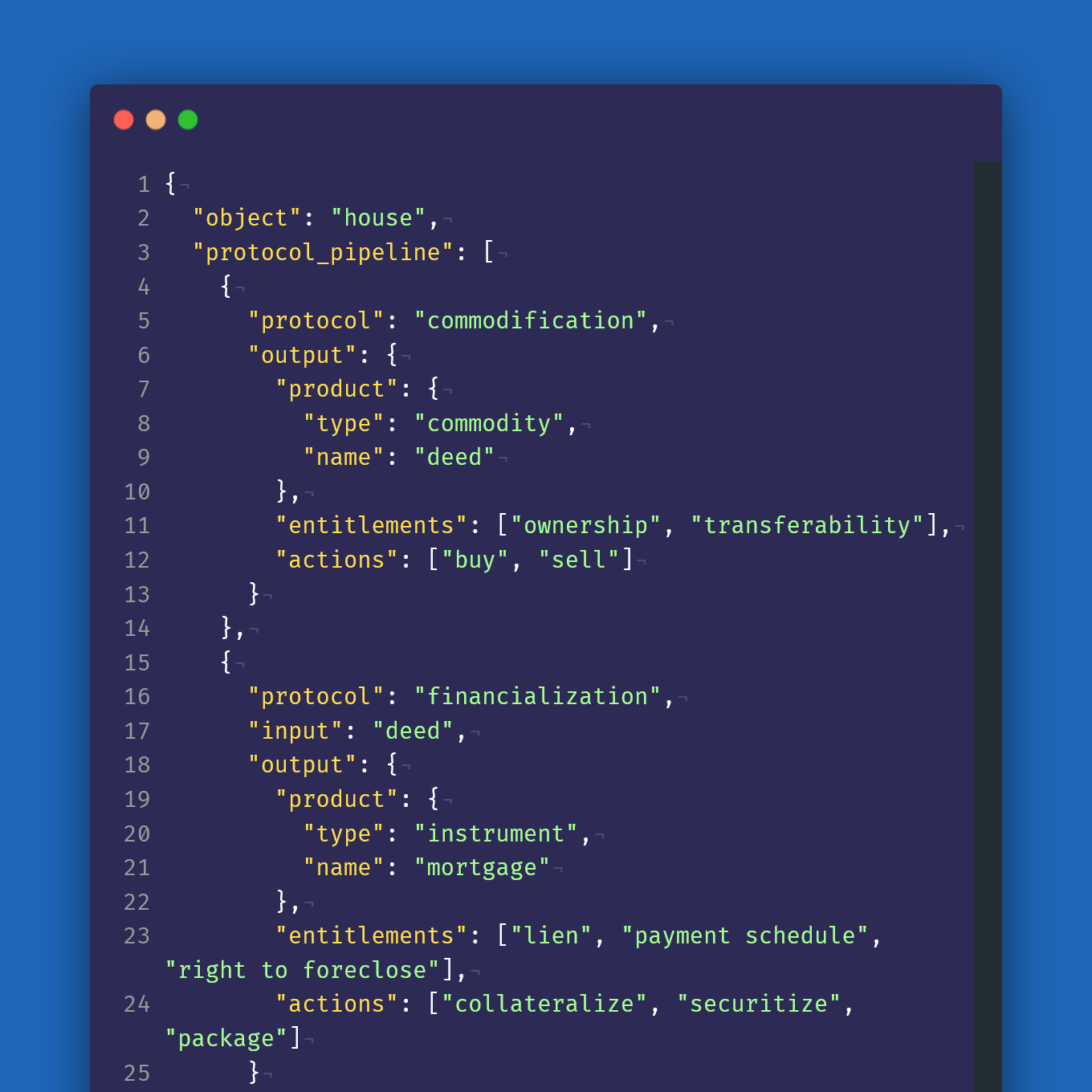
Alongside market failure = firm success, markets being like computer networks is the second insight that Misaligned Markets is built on. “Capitalism runs like a computer” is the blog post where I try to make this case, though not as well as I would have liked. The highlights of this post are:
- Both markets and computer networks are “trustful” and open systems where participants are prescribed roles that come with specific rights and privileges. Users may abuse those rights and privileges to gain advantages over one another.
- Market capitalism is a stack of “protocols” that enable market exchange. These protocols are built on capitalist institutions like courts, legislatures, and financial institutions whose actions create the boundaries of market reality. They determine what can be traded, tracked, and measured by creating property rights, enforceable financial claims, or market rating instruments that can be used to price things or signal quality.
- I refer to this process of creating market metrics, property rights, and financial claims as “capitalist serialization” which chops reality down into representations or “lossy” bits that can be acted on inside markets, ranked, recombined, and optimized.
- Market actors can either trick individual buyers (“corporate kung fu”) or they can “hack” the boundary where markets interface with capitalist institutions.
- Most of my blog posts up till that point had been about the former. In this blog post I use 2008 as an example of the latter, where financial institutions serialized mortgages into CDOs — an asset class detached from its underlying material reality.
The capitalist stack of anglo-capitalist societies

This post highlights the “stack” of institutions and political innovations that anglophone countries like the United States and United Kingdom rely on to enable capitalism. These include:
- Property rights, specifically those granted by a robust nation state able to provide resources for property disputes and enforcement of property protections nationally and abroad.
- Commodification
- Financialization
- Structured liability and contracts
- Capital accumulation
- Representative democracy, where property owners have substantive rights and representation
- Timekeeping and abstract value
- Market societies
Giving into hashtag AI hype

The last three posts of 2025 were exclusively about large language models because I’m a trend chaser in tech and wanted to help disambiguate what large language models (LLMs) can and cannot do.
- A (less) technical guide for understanding large language models. Is strictly about how LLMs work and the ways people use them. I don’t know who it's for, it might be too intimidating to read for someone completely unfamiliar with machine learning. The biggest takeaway is that LLMs are a mirror of language use and their capabilities emerge from the fact that high-level regularities of language actually encode for the types of “knowledge” LLMs display. LLMs are also lossy search that cannot recall this “knowledge” on demand. Basically they are the protagonist from Christopher Nolan’s Momento as a savant aging grandpa.
- LLM “intelligence” is a dark pattern. Large language models are a deceptive design pattern leveraging language fluency to create the appearance of emergent standalone intelligence. In actuality, LLMs are large, orchestrated systems relying on armies of engineers at runtime to maintain the very costly illusion of intelligence.
- AI hype is a mirror of market fundamentalism. In the last post of 2025, I put my political economy degree to work and talk about Adam Smith, Karl Marx, commodity fetishism, and alienation to describe how LLMs obfuscate the labor needed to make them “intelligent.” I then compare this obfuscation to the type of analytical blindness neoliberal economists have toward the mechanisms that enable markets.
There were lots of other posts, including a book list for charity that I ran at the begining of last year!
Anyway, If you’re looking for a deeper dive into my writing, check out my start here page or my one-year anniversary reflection blog post where I elaborate on other ideas core to my project. You should also subscribe to stay up-to-date with my latest blog posts and podcast episodes!