
To steer the future we must imagine a different past
Governance determines the evolution of an innovation, giving society power over a technology’s ultimate form.

When I was in my 20s, I wrote dystopian fiction. I imagined many worlds like one, for example, where the elite lived in technological enclaves. Their privilege granted them sheltered existences, shielded from news of wars and climate collapse, and they were only tethered to reality through interaction with humanoid robots piloted by the poor and incarcerated. At the time I couldn’t tell you why I wrote such stories, but now I realize I wanted to explore how the social context of a technology influenced its development. While my writing veered toward pessimism, I was reacting to the fact that, in America, we seem to have lost the ability or desire to understand the role social governance plays in shaping technological progress.
By governance, I mainly am referring to the legal, cultural, institutional, and economic actions that end up shaping how a technology diffuses and creates social progress. Our collective understanding of progress and innovation revolve around solitary, rock star maverick geniuses and a society of people primed to passively wait for The Next Big Thing.tm But this greatly simplifies what technology is and how it becomes useful. I’ve long moved on from writing fiction, though I recognize I’m now motivated to build a constructive vision of technological governance, given my extensive focus on negative externalities.
What is technology?
Before we talk about governance, it makes sense to define technology. Colloquially, we tend to think of technologies as standalone tools or inventions that are applied for a specific purpose. For example, knives are for cutting and beds are for sleeping. However, many anthropologists, sociologists, psychologists, and science and technology studies (STS) scholars understand that technologies and users are in a mutually transformative relationship. The use of a specific technology changes people, and that in turn changes the technology in an iterative feedback loop. It was this insight that led me to the core thesis of this project: Market capitalism is a runaway self-reinforcing social technology whose tensions require deliberate governance to manage.
Under this lens, technologies are composed of two parts: the first is the innovation itself (a novel tool or system); the second is the social and physical arrangement required for the innovation to function at scale. Sometimes, technologies emerge as a result of a society’s existing structure, like how communities near bodies of water tend to invent boats. For more complex technologies, a society may reorganize itself around the constraints and affordances of the technology. Cars, railroads, electricity, and the Internet functioned this way. Each required dedicated infrastructure to diffuse and ultimately changed how we lived and worked. Essentially, we shouldn’t just see technologies as tools but configurations of physical and social arrangements that co-evolve and reinforce one another. Governance, then, is the society-wide process of steering this toward better, more beneficial ends. In future posts, we’ll talk more about the types of co-evolving relationships, which are central to technological development.
What’s the importance of governance?
The 2010s saw an explosion of dystopian literature, and at the same time, there was pushback against what people viewed as the inherent pessimism of dystopian fiction. It’s “easy” to see what goes wrong, critics claimed, and much of our contemporary technology was inspired by positive science fiction of the past. By having society obsess over dystopia, critics argued, we failed to create an inspiring vision for the future and were robbing ourselves of a healthy relationship with technology.
I don’t fully subscribe to this, though I’ll happily admit that a lot of 2010s dystopian fiction, mine included, sucked. However, good dystopian fiction, like genre-defining works such as 1984 and Brave New World, highlights the social portion of technological development. A society that does not anticipate the social configurations a technology can produce will encounter externalities. This is how we got leaded gasoline, even when non-toxic fuel alternatives already existed. Beneficial technologies don’t escape this challenge either. For example, antibiotics have, over time, led to the challenging problem of antibiotic resistance because they select for stronger pathogens. Aside from more innovative agents, one of our solutions to address this is infrastructure for managing antibiotics use.
So, the move to simply imagine positive futures, especially without understanding implementation and social configurations, can lead to technological solutionism. This is the idea that any problem, even a second-order problem created by a technology, can be fixed with another technology. However, since most technologies result in co-evolutionary relationships, solutionism can end up inventing or recreating failures. This is because solutionism treats consequences as static and misses that implementation, not innovation, is the hardest part of making technology that is safe and useful.
I want to be clear that I’m not rejecting using technology to address social issues; this is a call to innovate deliberatively. Luckily there are whole fields with oceans of literature dedicated to this problem, like science and technology studies, which I’m hoping to cover in future posts.
One reason why talking about governance alongside innovation is critical is that many modern technologies would not have scaled or diffused into useful forms without governance. Could you imagine a world with cars without roads or rules of the road? What about electricity without power grids or regulation of utilities as natural monopolies? Planes without aviation standards? Governance is what enables an invention, like a single Model T, to become something that can be used by society more broadly. This is why one of the best things we can do to shape the future is to understand governance so that we can better participate in this process. This can take the form of understanding a technology’s constraints, building adaptive institutions, and making space for people who are harmed by a technology to discuss their experiences.
There is actually a genre of science fiction about governance, and it’s almost singlehandedly dominated by Kim Stanley Robinson. Okay, that’s not fair… There are other writers in this space, but it definitely isn’t a common genre of science fiction, and Robinson’s Ministry of the Future is a standout here, even having been recognized by the United Nations. However, you don’t have to be a science fiction writer to engage in this exercise. As the title of this post suggests, I think looking at past technologies and understanding aspects of their implementation and diffusion can help us understand aspects of governance that we can take with us going forward.
Imagining the history of the Internet as a railway
The best way I’ve found to make governance concrete is to look at a technology we’ve already lived through and ask where the steering actually happened. The Internet is a particularly rich case because it’s recent enough to trace and complex enough to show governance operating at every layer. The lessons from this exercise are definitely useful going into current debates over AI. In fact, part of the reason I started thinking about this is that the AI bubble hearkens back to fights from the earliest days of the World Wide Web.
While we think of the Internet as one thing, it is better conceptualized as a stack of technologies, each with a highly contingent existence. There are dozens of worlds where the Internet is functionally different, not just for technical reasons. This makes the Internet a great microcosm to explore questions related to technological governance and diffusion. By asking ourselves counterfactual questions, we can imagine different trajectories for the Internet and thus society as a whole. I’ve begun outlining these with a model I call the Great Technological Railway (GTR).[1]1 The GTR imagines the history of a specific technology, like the Internet, as a series of rail stations and junctions. While this is predominately a visual metaphor that maps the genealogy of a technology’s development, it also leverages the features of railways to convey important aspects of technological diffusion.
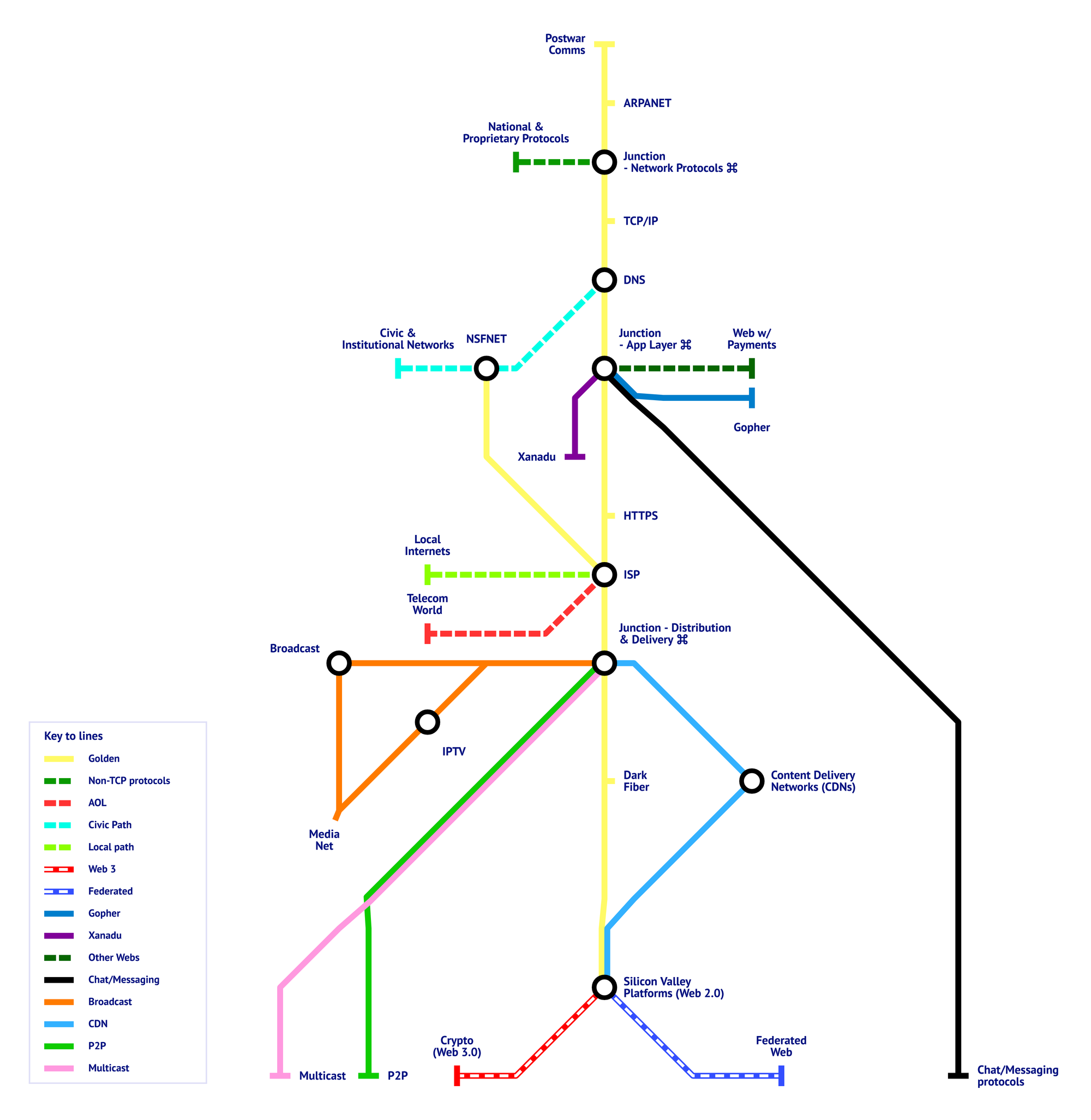
Above is a GTR of the Internet. We’ll do a full analysis of this image in a minute, but first let me explain what the routes of the GTR signify.
- Regular stations. Stations are major technological developments that fundamentally change capability or access. Protocols like TCP/IP, DNS, or HTTP are stations: once they exist, entire classes of applications become possible.
- Junctions. Junctions are places where multiple solutions were possible. At these points, engineers, governments, users, and firms chose between alternatives—TCP/IP versus its many alternatives, HTTP versus Gopher, centralized platforms versus federated systems. Each junction leads to tracks that may become dominant routes or quiet sidings.
- Dashed ghost stations. Ghost stations are alternate worlds on routes that were rarely traveled or taken. They are either abandoned infrastructure or purely speculative parallel worlds that can be imagined if a single vision of the Internet won.
Trains in the GTR implicitly carry something when they travel from station to station, which symbolizes the diffusing effect of a technology. Every technology diffuses something different, but the Internet, as a piece of infrastructure, diffused scale and network effects. At every successive stage of complexity, the Internet was able to support more people and more applications, which newer stations have benefited from.
Internet history on the Great Technological Railway (GTR)
As a form of counterfactual analysis, the GTR is not meant to provide a god’s-eye view of a technology’s history. Rather than providing a full story or genealogy of a technology, the GTR constructs relationships on the basis of what is being analyzed. In this case, I’m interested in questions like:
- How does changing the “ownership” of a given station change a given technology? Many of the Internet’s core protocols are open source, funded by government and academic research. There were, however, proprietary alternatives. What type of Internet emerges if, say, HTTPS were a product one had to pay for? Does that kill the Internet altogether or change the trajectory of the Internet and who it grants power to?
- Where did value hand-offs or transfers happen within the Internet’s history?
- What were off-ramps away from the current Internet? These are historical, as in we don’t have them today, but understanding what they could have been could maybe give us hints about what other possible internets could look like.
This GTR image is organized based on my current knowledge about the Internet’s history, which is limited, as I’m still learning. Technologies are not necessarily ordered in the sequence in which they were created but by what layer or stack of the Internet’s functionality they service. This kind of roughly aligns with dates of creation, but I’m mainly trying to model places where choice points, real or imagined, existed.
Like most counterfactual analysis, there is a degree of discretion when it comes to what to look at and emphasize. The map is far from comprehensive, and as I said, it’s limited to my current knowledge of the history. Though I imagine attempting to map the entire history of the Internet with a GTR would probably be too unruly. This V1 is a proof of concept exploring the idea of thinking of history this way. With V2, I’m hoping to choose a specific sliver of history to examine in more granular detail.
Let’s walk through the current map now:
The golden path
The yellow line, or “golden path,” as I’ve called it, takes us through technologies that are critical parts of the Internet’s history. These are either direct predecessors to today’s Internet (like ARPANET) or are protocols used in modern networking stacks (TCP/IP or HTTPS):
Postwar communications
This serves as a “yard,” where the story for the Internet can be considered to reasonably begin.[2]2 Companies like Bell Labs (previously owned by AT&T) are central to this story, as they helped develop technologies like reliable transistors, modems, and Unix, which are essential to modern computing. Critically, though, Bell Labs missed the chance to develop ARPANET (the first version of the Internet) because they wished to create their own proprietary alternative and failed. Paradoxically, as AT&T was a “common carrier” legally required to let people plug devices into their lines, they inadvertently provided the playground for the very modems and devices that would eventually bypass their control. This ensured that the Internet’s precursor remained a public experiment rather than a proprietary corporate utility. Technology from companies like Bell sits alongside public experiments, like those carried out separately by the US and French governments. This history provides an important lesson. Governance isn’t just regulation, but the full interaction of corporate strategy, regulatory obligation, and social values playing out simultaneously. It’s a very messy and very public real time process that has almost little to do with a technology’s specifics.
Anyway, it’s extremely significant that not only did Bell Labs fail to develop ARPANET, but that their infrastructure was indirectly leveraged to facilitate the experimentation that led to the Internet. We could very easily imagine a world (likely the one we live in) where, contrary to social values of openness, we prioritize value extraction and guaranteeing incumbents rents for eternity. In such a world this kind of experimentation wouldn’t be possible.
ARPANET
Funded by the US government but executed by university researchers, ARPANET is the first “station” of the Internet. While its military funding via ARPA (now DARPA) was rooted in Cold War contingency planning, ARPANET ultimately became a social experiment in resource sharing. This “academic governance” gave birth to the Request for Comments (RFC) process. Started by grad student Steve Crocker, the RFCs established a governance culture where technical standards were “comments,” not “orders.” Further developments, like the invention of email, shifted the network from a niche tool to something that allowed for the decentralized spread of information. Given that the project was led by academics, the unusually open and exploratory nature of ARPANET was perhaps inevitable, despite its military origins. Ultimately, ARPANET proved that a distributed network was possible, effectively shifting the trajectory of communications from a series of closed, proprietary pipes to an open, shared commons.
TCP/IP (Transmission Control Protocol and Internet Protocol)
Invented by Vint Cerf and Bob Kahn, TCP/IP is a decentralized protocol (owned by no one) that serves as the backbone of modern computer networking. It is the next critical “station” on the track after ARPANET. Alongside TCP/IP sit other protocols, some private and some public, that ultimately did not become the basis of today’s internet. These ghost stations remain unfinished and untraveled, representing roads not taken where the Internet would have been managed by international committees or telecom monopolies. The conflict between these systems (dubbed the “Protocol Wars”) was less a battle of efficiency and more a battle of governance. OSI was “top-down,” favoring observability; TCP/IP was “bottom-up,” favoring “rough consensus and running code.”
TCP/IP’s victory was not an inevitability due to it being better but, arguably, an artifact of social decisions and path dependency. It won because a series of historical accidents led to the ubiquity of the protocol outside of academia before anything else could take off. TCP/IP plays a crucial role in the Internet as we experience it today. As a protocol, TCP/IP ensures that control over how data moves sits with the devices sending and receiving it, rather than with the network itself. This made it structurally difficult for any single entity to control what traveled across a network. Every subsequent battle over internet governance—from ISP neutrality to platform power—is in some sense a fight over whether that founding architectural choice can be overridden by economic or regulatory force.
Domain Name System (DNS)
DNS is the Yellow Pages of the Internet;[3]3 it keeps a record of the domain name every server answers to. Prior to DNS, a team at the Stanford Research Institute, led by Elizabeth “Jake” Feinler, personally managed this directory in a single file. As the network scaled, however, this manual file became a bottleneck, leading to the creation of the system we use today. While DNS functions as a technical hierarchy, it is one overseen by a governing body—a “root” that remains one of the Internet’s few centralized pieces of infrastructure. The composition, rights, and authority of that governing body continue to be hashed out in public.
HTTPS (Hypertext Transfer Protocol/Secure)
Alongside DNS, HTTP(S) is one of the most recognizable pieces of internet infrastructure; it is the protocol that allows webpages to exist. Like the “Protocol Wars” of the 80s, which threatened the existence of TCP/IP, there were myriad systems competing to be the interface for the Internet. Ultimately, the vision of Tim Berners-Lee—an academic of a similar vein to earlier ARPANET researchers—won out. By refusing to patent the system and ensuring CERN released it into the public domain, Berners-Lee steered the train away from private, toll-gated tracks like Gopher. However, HTTP was famously incomplete. Features like identity and payments (notably the unimplemented 402 Payment Required HTTP Error) were envisioned but never created. This missing infrastructure created a vacuum that was eventually filled by the Silicon Valley platforms we use today. There is a parallel world where features like payments are part of the open commons and not facilitated by Stripe and PayPal, preventing the Big Tech hubs from gaining the massive social and economic value they now control.
ISPs (Internet Service Provider)
ISPs are the gatekeepers that connect the individual user to the global network of tracks. In the early days of the Internet, access was limited to the NSFNET, the successor of ARPANET. Managed as a publicly funded academic network, NSFNET functioned as the Internet’s “mainline,” allowing for communication among researchers and students across U.S. universities. In the early 1990s, however, the government made a pivotal decision to relinquish its role in managing this system. By decommissioning the NSFNET in 1995, they intentionally steered the train away from public management and into the hands of commercial owners. This transition forced the Internet to reorganize around the commercial ISP model. These private entities became the new station masters, responsible for laying the expensive “last mile” of tracks into homes and businesses. While this privatization allowed the Internet to scale at a speed the government could not match, it also transformed internet access from a shared academic commons into a commercial utility. This placed the power to steer the network’s flow into the hands of private gatekeepers.
Dark Fiber Overbuild
The dot-com boom of the late 1990s illustrates how speculative mania can accidentally build the future. Believing the Internet was the imminent center of all human activity, telecommunications companies laid millions of miles of fiber-optic cable well before there was enough traffic to fill them. When the bubble burst in 2000, this “dark fiber” (cables laid but not yet “lit” with data) remained in the ground as a stranded asset. This massive oversupply effectively subsidized the Internet’s growth for the next thirty years—making bandwidth artificially cheap. It allowed for the development of data-heavy applications, like streaming video, that the Internet’s earliest architects could barely imagine as practical. While this era of excess was essential to the Internet as we know it today, it remains a commercial layer built on top of the earlier public foundations of the Internet. As previous sections of this post illustrate, there is definitely an internet without dark fiber, and we’ve lost something in the bandwidth-rich world of the dot-com bubble.
Silicon Valley “Web 2.0” Platforms
Web 2.0 was not a technical upgrade to the Internet’s tracks but a radical reorganization of how internet participants interacted. While the previous era was defined by read-only information and decentralized personal sites, Web 2.0 ushered in the read-write web, where users became the primary creators of content. This transition was fueled by the dark fiber overbuild, which provided the cheap bandwidth necessary for data-intensive platforms like Facebook, YouTube, and Twitter to function at a global scale. In this configuration, governance was steered away from the open commons and into “walled gardens” or private platforms that utilized the open protocols of the Internet to build centralized, proprietary ecosystems.
These platforms represent a profound sociotechnical shift: the “product” being moved along the tracks is no longer just data, but human attention and personal metadata. By providing convenient, centralized hubs for social interaction, these platforms have gained enough momentum to dictate the rules of digital life, moving the power of governance from public standards to private corporate algorithms and terms-of-service agreements.
A world dominated by a handful of multi-billion-dollar companies was not a future foreordained. Events like the decommissioning of the NSFNET and the dark fiber overbuild are what made our current reality more likely. As I said elsewhere, much of Silicon Valley companies’ value comes from inherited network effects present at lower protocol layers, built-in earlier decades of the Internet’s life. These companies are essentially operating high-traffic tollbooths.
Alternate routes and modern junctions
Fully solid lines that are not part of the yellow line are technologies that exist but either weren’t adopted or are used concurrently with today’s technologies. These include:
Dead ends
These are routes that were either partly or completely built but irrelevant to the Internet as it exists.
Xanadu
Project Xanadu represents the Internet’s most famous “ghost station.” Conceived by Ted Nelson in 1960, Xanadu was intended to be a global library where every quote was a live “transclusion” from the original source. Unlike the World Wide Web, which relies on “dumb,” one-way links that frequently break, Xanadu was designed to be bi-directional and permanent, with a built-in social arrangement for copyright and micropayments. Its crown jewel was transclusion, a system where you didn’t copy text but rather created a virtual pointer to the original source. This ensured authors could be paid every time their work was referenced. Xanadu is worth discussing despite the idiosyncrasies of its creator because it actually predicted and attempted to preemptively avoid many of the Web’s current flaws. Xanadu shows that while it might be feasible to build a better system in advance, viable systems are deployed and publicly iterated on through social and legal governance.
Gopher
Before the golden path of the World Wide Web was solidified, Gopher was the track most likely to become the global standard interface of the Internet. Developed at the University of Minnesota, Gopher was a hierarchical, menu-driven system—a librarian’s dream that organized the Internet into neat, nested folders. It was faster and more organized than the early web, but it serves as a cautionary tale of how a single social decision can derail a technology’s momentum. In 1993, the university suggested it might charge licensing fees to commercial users, effectively attempting to place a tollbooth on a track the community believed was a public commons. This social friction, combined with Gopher’s rigid file tree structure, caused the train of governance to jump the tracks toward the royalty-free and more flexible World Wide Web. Today, Gopher remains a fully solid parallel line: a functional but lonely path that proves the “best” technical arrangement can easily be rendered obsolete.
Live alternate tracks
These are tracks that are still in use but not part of the golden path.
Chat and Messaging Protocols
Messaging protocols represent the shift in the Internet’s social arrangement from asynchronous letters (email) to real-time presence. This evolution began with BBS or Bulletin Board Systems—local, dial-in hubs that functioned as isolated digital villages governed by a “SysOp” (System Operator).
As the network expanded, IRC (Internet Relay Chat) emerged as the first open, decentralized standard for global conversation, mirroring the academic and hacker ethos of early protocols like TCP/IP. However, the nature of chat took a sharp turn toward centralization with the rise of AIM (AOL Instant Messenger) and ICQ. These were the first major “walled gardens,” introducing the proprietary “Buddy List.” Unlike email, these platforms were not interoperable; social interaction was constrained within the provider’s specific system.
XMPP (Jabber) was later developed as a technical solution to this fragmentation—an open standard designed to link all messaging platforms together. While initially adopted by early versions of Google Talk and Facebook, XMPP eventually became a “lost standard,” as these companies chose to cut the tracks to interoperability in favor of user lock-in. Today, messaging remains a landscape of functional but disconnected silos, where the social value of the network is captured by the platform owner rather than the public. While older protocols like BBS, IRC, and XMPP still exist, they have been relegated to niche communities as the broader public has migrated to centralized Web 2.0 platforms. However, their ethos of open interoperability lives on in the modern Federated Internet (the Fediverse), which leverages decentralized protocols to power services like Mastodon and Matrix. These are valiant attempts to steer the social web back toward a public commons.
Content Delivery Networks
In the late 1990s, as the Internet transitioned from a text-based academic tool to a commercial medium, it hit a physical performance wall known as “The World Wide Wait.” The original technical arrangement, where a single central server responded to every individual request, could not scale to a global audience. When a site became too popular, its server would simply fail under the weight of the traffic. Content Delivery Networks (CDNs), pioneered by companies like Akamai, emerged as a technical fix to this instability. By placing thousands of servers at the “edges” of the Internet, CDNs allowed websites to cache information closer to users, bypassing the congestion of the long-distance public tracks.
From an analytical perspective, CDNs represent a major value handoff in the Internet’s history. The responsibility for a reliable user experience shifted from the individual website owner to a specialized delivery layer. This move helped stabilize the Internet during its most volatile growth period and enabled the high-bandwidth utility we see today, like video and software updates, which would have otherwise crashed the original protocols. While not a “walled garden” in the social sense, CDNs represent a shift toward a tiered infrastructure: the Internet became functional at scale only by delegating its most demanding tasks to private intermediaries. This ensures that the web remains fast and reliable, but it also means that the utility of a decent connection is often a proprietary service rather than a universal standard of the public tracks.
Broadcast and IPTV
Before the lighting of the massive amounts of dot-com bubble era dark fiber, various approaches to high-bandwidth activities were attempted to work around the physical constraints of the early 90s and 2000s. One-to-many distribution schemes, such as early IPTV and broadcast internet, saw telecom providers literally “pushing” content at specific times over internet protocols. In this configuration, the Internet functioned less like a web and more like an intermodal version of cable TV, where the social arrangement remained passive and top-down. This model eventually became irrelevant, as the physical tracks (via dark fiber) grew wide enough to accommodate millions of individual, high-bandwidth “pull” connections—transforming the user from a spectator into a dispatcher. However, there is a counterfactual world where these broadcast schemes dominated, and the Internet remained a series of curated walled gardens. In that world, the 20th-century telecom monopolies would likely have remained the station masters of digital life, functioning as the equivalent of today’s Big Tech.
Multicast
Like broadcast, multicast was trying to solve the problem of distributing high-bandwidth data loads without causing the network to crash. Unlike broadcast, which pushes data to everyone on a local link, multicast allows a single stream of data to be replicated by network routers for those who “opt-in.” In the 1990s, the development of the MBone (Multicast Backbone) was an attempt to steer the Internet toward a future of synchronized, global live media with the efficiency of traditional television. For the system to work, every ISP along a data’s path had to support the same complex routing protocols. However, the system lacked a viable mechanism for value transfer: transit providers often found themselves doing the heavy lifting of duplicating data for thousands of users without a clear way to bill for that extra work. This economic friction caused the train to steer away from this coordinated model and toward the “brute force” commercial fix of CDNs. While IP multicast remains a functional parallel line used in corporate networks, its absence from the public web is a reminder that technical efficiency is often sidelined if there is no clear way for station masters to capture value from it.
P2P
P2P represented a radical, decentralized attempt to solve the distribution problem, gaining massive momentum through protocols like BitTorrent and services like Napster, Kazaa, and LimeWire. In the late 1990s and early 2000s, this was briefly the predominant mode of distributing media across the Internet. Like CDNs, P2P utilized an “edge-based” arrangement, but instead of leveraging a private intermediary, the utility was provided by neighboring peers under the control of no single actor. This flipped the problem of user congestion and bandwidth on its head: because the load is distributed across the entire user base, the system’s capacity actually increases as more people join.
From a governance perspective, P2P was a bid for a decentralized social contract based on direct reciprocity rather than a central manager or tollbooth. This evolution moved from “hybrid” stations like Napster to “pure” protocols like BitTorrent. Since BitTorrent has no central dispatch to shut down, the train of public interaction proved nearly impossible for authorities to steer or stop through traditional means.
The ultimate failure of P2P to become the Internet’s dominant mainline was due to its refusal of formal governance. By providing immense utility without a mechanism for rewarding creators or managing ownership, P2P created a “governance vacuum.” This allowed established station masters, such as ISPs, to frame the entire track as a criminal bypass. The conflict led to the first major acts of traffic throttling, where ISPs deliberately steered passengers away from these tracks by slowing their progress to protect their own ability to monetize Internet traffic. Because the P2P protocol itself captures zero value from the exchanges it facilitates, it remained an economic off-ramp that was eventually closed in favor of the more “manageable” and profitable centralized stations of the modern era.
Ghost stations and counterfactual worlds
In the GTR, dashed lines are “possible worlds” that do not exist but could have if decisions governing a technology went differently. I alluded to a few of these in the previous sections:
- Non-TCP protocols
- Networks centered around NSFNET
- Local-centric Internet services
- Telecom-dominated Internet
- Broadcast-dominated Internet (Media Net)
The path to these worlds is lined with tracks built from different sets of governance decisions. Some of these worlds, like the non-commercial networks of the NSFNET, may sound ideal in the “technofeudal” world of 2026. Others, like the telecom-dominated Internet, seem like bizarre novelties. Additionally, two competing, alternative visions of the future of the Internet are being built right now:
- Web 3.0/Crypto. Frankly, I don’t know what to make of Web 3.0. It seems to have failed at its original vision, confused as it was, and is now just a logical extension of contemporary finance and Web 2.0.
- Fediverse. I’m still learning about the Federated Web despite being on Mastodon for over a year now. Regardless, I’m giving it a shoutout to highlight that the incentive to build alternative tracks for the Internet is ongoing, as are our governance battles over this technology.
Brief lessons on steering the future
As I said before, I’m still learning about the history of the Internet, but some very important lessons around social and technological change already stand out:
1. Incomplete solutions are better than ideal ones
The tracks that are laid and lubricated first are the ones that get used. Often, this means that a flawed version of a technology is the first to get wide adoption. The focus of governance is usually to improve rather than recreate a technology. Xanadu is a great illustration of this. While Nelson seemingly foresaw fights over attribution, ownership, and payments, none of these matters since Xanadu was never deployed, played with, or even poked. In many cases if you want to ensure the existence of a technology that preserves your values (as the creators of TCP/IP and HTTPS did) releasing something good enough is well… good enough. The existence of HTTPS status code 402 is a testament to the fact that the creators of the Web know we never got the perfect version of their vision. Nonetheless, it was critical that they released HTTP(S) when they did.
2. Nature abhors a governance vacuum (Beware the double movement)
Every step of the Internet’s golden path resulted in increasing levels of formal governance. Nowhere is this clearer than with the growth of P2P services. Before the success of iTunes, P2P was a legitimate station that could have been implemented on the Internet’s golden path. But the inability for rights holders to call foul and ISPs to profit off P2P activity gave them incentives to design rules of the web that effectively siloed mass P2P adoption.
Absence of formal governance does not mean no governance, it just enables societal tensions to play out in public. However, this is not a tenable state long term and eventually, affected sections of society push back with what power they have to mitigate the effects that technology has on them. Austro-Hungarian economic historian Karl Polanyi referred to this as the “double movement.” This is why governance is not just about institutions legitimizing technologies, but about how stakeholders choose to leverage institutions to control the direction of a technology.
3. Lay tracks before they’re needed
Stories like the insane dot-com era dark fiber build-out show that the tracks that get used have often been laid well before they’re even needed. This ensures that when a pain-point emerges, like low bandwidth in this case, the tracks can be switched to just in time.
4. Enclosure is an ever-present incentive
In 2018, Google removed mentions of “don’t be evil” within its code of conduct. The company by this point had moved beyond its quaint vision of connecting users with the best content on the web, having become a sprawling advertising behemoth whose trackers extended to appliances in the home. Why did this happen? Well, providing the best search engine on its own was not a sustainable enterprise. When you actually solve someone’s problem and do so in a way that other people can modify, you’re unable to make durable profits.
The Internet as a technology has served as a battleground between software intended to solve a problem and software intended to rent-seek. Many Silicon Valley companies started out doing the latter, like Google, which simply wanted to provide the search engine. However, over time, these companies realized that in order to be profitable, they had to capture value rather than simply create it. Today, many of these companies serve as wrappers over existing social relationships, allowing them to function as middlemen whenever you interact with anyone and anything—from your friends to other companies—through their platforms.
There’s an oft-repeated phrase—if it’s free, you’re the product—used to describe why this current state of affairs is obvious. But that’s actually not been true for some time. You’re always the product wherever there’s a codified social relation or an enforceable asymmetry of action to profit from. General Motors, for example, was selling automobile telemetry of people who bought their cars to insurance companies who then raised those individuals’ premiums. This phenomenon—turning paying customers into captive revenue streams—may seem like “double-dipping,” but capitalism lets sellers and market makers ultimately decide what it is they offer and extract.
5. Enclosure always happens after you’ve gotten comfortable
As Gopher illustrates, enclosing, even when you’re creating value, may not be a good idea. This seems to be a lesson that Silicon Valley took to heart, as they used blitzscaling to indefinitely create lots of value before locking the gates long after competitors died. This means if you’re using a service that seems too good to be true, you should question the business model and consider if it ends up with your options being constrained.
6. If you’re a passenger, avoid riding to stations without exits
If you can see enclosure coming as a user of an emerging platform, it’s probably best to just get off the train before you get stuck at the upcoming station.
7. …But if you’re trapped, plan and make your own exit
Governance is often adversarial, like 19th-century factory workers rioting for basic factory safety standards or Amazon sellers boycotting the company’s Ads platform in 2026 for better policies. When it comes to enclosed internet platforms, however, it can feel impossible to escape. That’s why sometimes you’ll have to make your own exit. Writer and activist Cory Doctorow proposes doing this through what he calls adversarial interoperability—finding unintended ways of exporting your data or value from an enclosed tech platform so you can leave it.
A great example of this was a tool I used to find people I used to follow on X.com on other social media websites so I could freely interact with them elsewhere. Incidentally, tech incumbents faced a similar problem before they dominated the web. For example, in the mid-2000s, Myspace was too big for Facebook to compete with on features, so Facebook deployed a bot that would access your Myspace account and retrieve your messages and friends in order to create interoperability that enabled people to leave Myspace en masse.
8. There’s no shame in building on old tracks
Some of the Internet’s oldest tracks are still alive, even if they’re not on the golden path and people are building things atop them. For example, XMPP is still an actively maintained open-source, decentralized messaging protocol that people are building useful applications on. There are also people who’ve chosen, for whatever reason, to remain on older, less popular protocols like IRC and BBS to build communities away from the gazing Silicon Valley station masters, holding whole metaphorical trains of users hostage at the Web 2.0 station.
Other technologies will present different lessons
While the lessons I’ve discussed most specifically apply to the history of the Internet, no two technologies are the same. In future articles, I hope to look at the history of governance of other technologies like cars, trains, factories, and electricity to get a more general understanding of this process. My goal is to iterate on the GTR concept, or abandon it entirely if it doesn’t prove fruitful.
But if you’re concerned about the trajectory of AI and want to see me use the GTR for another technology, read my recent AI bubble blog post.
If you liked this blog post support my tea habit by tipping me!
- If you read my AI bubble post you've already encountered this idea. This post is intended to elaborate on it further with details about the internet technologies included in this GTR and the lessons we can learn from them.
- Okay, if you’re being a pedant, I guess you could include electricity and knowledge of physics as the true origin of the Internet's story, but we're not doing that.
- Congrats to anyone young enough to not know what I'm talking about.