
Greed is not selfishness
Greed is not just a personal vice but something far more dangerous.
This post was orignally posted on Medium earlier this month. For current readers of this blog, many of the ideas in this post were expressed in earlier posts containing the Mammon metaphor.
Inequality has arguably been the defining political issue of my lifetime. I went to college during the Occupy Wall Street movement, with 2012 being the first presidential election I was eligible to vote in. Since then, by many measures, inequality has not gotten better in the United States. Today, the top 10% of wealth and income earners hold the vast majority of stocks and make up 50% of consumer spending, while the rest of Americans use gig work and debt to finance their lives. This is without getting into the influence of wealth in our politics, how AI companies are offloading utility costs onto regular consumers, and the many other documented ways the bottom 90% of Americans feel the system is rigged against them.
Greed is a word commonly used to explain the stark disparity in the lived realities of different Americans. From greedy billionaires not paying their fair share in taxes to greedy businesses engaged in corporate kung foolery, it’s seen as a personal vice of the wealthy who are too insulated to care about the rest of us.
I don’t think this level of description is useful, but not because it’s completely false. Psychology literature on money, power, psychopathy, and even personal anecdotes of billionares paint provide some evidence that the ultra-wealthy might have less empathy. However, I don’t think greed, as it’s commonly understood, explains capitalism as a system of wealth maximization, nor is it uniquely descriptive of our era. It’s not like today’s broligarchy are orders of magnitude greedier than yesteryear’s robber barons.
Right word, wrong definition
Greed under capitalism is fundamentally a different beast. It’s a systemic pathology that can really only be understood in relation to how it transforms the world. Luckily, there’s an old text we can turn to that perfectly illustrates this. No, not the Bible, something much, much older.
In Book 1, Part 9 of Politics, Aristotle distinguishes between two modes of using money:
- Oikonomia (οἰκονομία). The art of household management. Accounting for money as a means of satisfying one’s necessities (food, clothing, housing, etc.) so that life can be enjoyed.
- Chrematistike or chrematistics (χρηματιστική). Wealth-seeking for the sake of having more wealth. Accumulating money without end.
Towards the end of Part 9, Aristotle has some damning words to say about chrematistics (often translated as “wealth-getting”):
Hence some persons are led to believe that getting wealth is the object of household management, and the whole idea of their lives is that they ought either to increase their money without limit, or at any rate not to lose it. The origin of this disposition in men is that they are intent upon living only, and not upon living well; and, as their desires are unlimited they also desire that the means of gratifying them should be without limit. Those who do aim at a good life seek the means of obtaining bodily pleasures; and, since the enjoyment of these appears to depend on property, they are absorbed in getting wealth: and so there arises the second species of wealth-getting. For, as their enjoyment is in excess, they seek an art which produces the excess of enjoyment; and, if they are not able to supply their pleasures by the art of getting wealth, they try other arts, using in turn every faculty in a manner contrary to nature. The quality of courage, for example, is not intended to make wealth, but to inspire confidence; neither is this the aim of the general’s or of the physician’s art; but the one aims at victory and the other at health. Nevertheless, some men turn every quality or art into a means of getting wealth; this they conceive to be the end, and to the promotion of the end they think all things must contribute.
For Aristotle, chrematistics is a perverse substitution of what things are, untethering the purpose of an activity from the value of that activity. Like a Midas touch, chrematistics robs the world of its complexity by reducing everything else to a single thing that cannibalizes the environment to reproduce. Aristotle all but predicts enshittification, extractive private equity, and the military–industrial complex as he lists examples, like healthcare and defense, where wealth-seeking can worsen the performance of the activity.
What makes Aristotle’s critique so powerful is that it describes more than a psychological state or vice. Even if Aristotle encountered it as a personal disposition, chrematistics describes a pattern that can outlive the people who initiate it through systems of behavior that affect others. More importantly, chrematistics points to a universal principle beyond wealth. When people mistake ends (a goal) with means (how to obtain it), they can paradoxically end up further away from what they truly want. In the case of wealth, while it might seem like having unlimited wealth means you can have unlimited things, pursuing this turns the acquisition of wealth into your ends, as that is what is required to actually maintain unlimited wealth.
Something similar can easily happen with other goals. Consider the No Child Left Behind policy, which reduced educational success to test scores and resulted in teachers “teaching to the test.” You have likely also encountered this at work, where your manager might have chosen to judge your performance in ways unrelated to the value of what you do. The lesson from Aristotle’s chrematistics is that if you do not decide your goals and the metrics by which you evaluate them carefully, you can end up practicing a dark and perverse art.
Capitalism as a “greedy optimizer”
Capitalism clearly elevates Aristotle’s chrematistics into a personal virtue, but this moral framing is better understood as a proximate cause of the system’s more problematic tendencies. To see why, let’s step away from talking about people and instead talk about decision-making processes.
In computer science, an algorithm is a rule or process for breaking down a problem into steps so that it can be automated. Different algorithms embody different tradeoffs, like speed versus accuracy or local accuracy on a single step over global foresight managing the whole problem.
A greedy algorithm is one example. At each local step, it selects the option that appears to be the best at that given step, disregarding how that might impact performance on future steps or the entire problem.
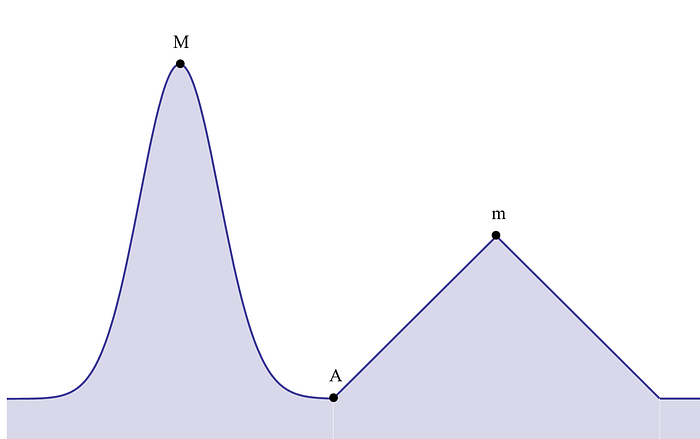
For a problem whose solution is dependent on the accuracy of previous local steps, this can be risky and result in a global or complete solution that is suboptimal. This can even be true if the work done at every local step was acceptable. That’s why greedy algorithms are reserved for problems that are simple, easy to break down, or can accept approximate global solutions.
Aristotle’s concern with chrematistics shares a similar structure, with his objections rooted in the fact that unbounded metrics like wealth have no internal stopping condition. Once wealth becomes a measure of success, it becomes a runaway process decoupled from any particular “global” optimal outcome aside from its own reproduction. When seen from this perspective, greed isn’t solely a character flaw. Aristotle’s notion of greed directs our attention to any process that privileges immediate, easy-to-measure gain while systematically disregarding the impacts of that measure on the conditions under which future action will take place.
Markets under capitalism don’t simply promote Aristotle’s chrematistics as a virtue; they resemble the structure of a greedy algorithm. Within the system, decisions are rewarded according to locally legible signals like profit and growth, while longer-term global effects on societal structure or environmental stability are external to the algorithm. Over time, this reproduces actions that improve these easy-to-measure metrics while degrading the conditions required to maintain the system. This is where the “misaligned” in “Misaligned Markets” comes from. It describes an optimization process whose processes are stuck reproducing results that do not fully capture what we need for long-term flourishing.